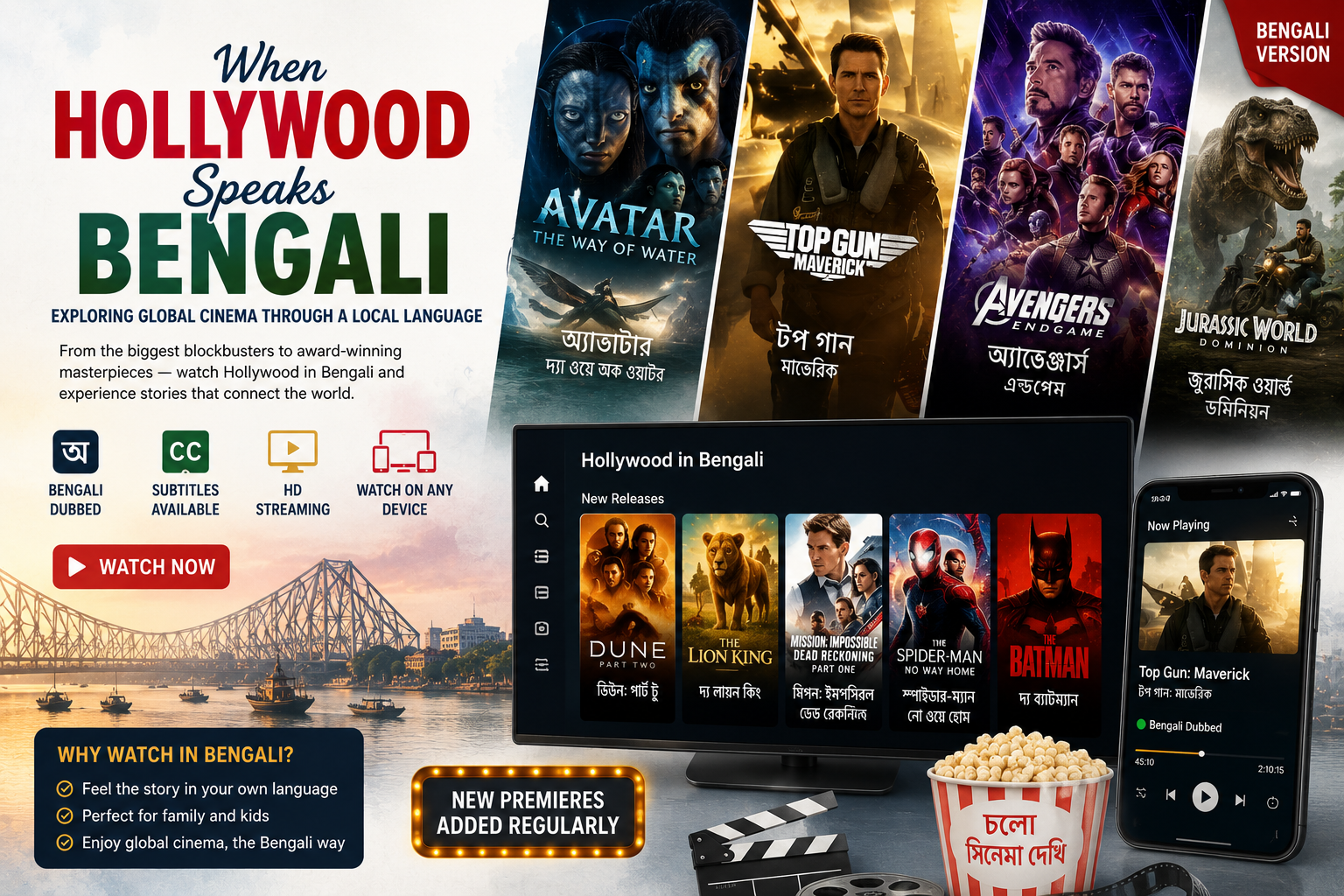
Hollywood cinema has a worldwide reach, but language can strongly influence how comfortably audiences connect with international entertainment. Bengali-speaking viewers have increasingly gained access to Hollywood productions adapted for local audiences through Bengali dubbing and other language-accessibility options. This creates an interesting meeting point between global filmmaking and regional viewing culture. For audiences searching for হলিউড মুভি বাংলা, the online environment offers a convenient way to explore international cinema through a Bengali-oriented catalog rather than depending only on conventional television schedules or imported physical media.
Hollywood Without the Language Barrier
Watching an international production in its original language is not the only way audiences can experience Hollywood cinema. Bengali dubbing has developed into a recognizable part of the regional entertainment landscape, with dedicated collections and digital channels offering Hollywood productions in Bengali. Current online listings show that Bengali-language versions can span multiple genres and eras, demonstrating that localization is not restricted to one particular type of international film.
For Bengali-speaking audiences, localization changes the accessibility of the catalog. Instead of concentrating entirely on subtitles or requiring familiarity with English dialogue, viewers can approach international entertainment through a language that feels more natural in everyday viewing. This can be especially useful for families and viewers who prefer listening to entertainment in Bengali while retaining access to global cinema.
The significance of this format goes beyond translation itself. A dubbed production can feel more immediately approachable because the viewer does not have to divide attention between visual action and reading subtitles. The language becomes part of the viewing environment, creating a more familiar bridge between international cinema and Bengali-speaking audiences.
The Rise of Localized Global Entertainment
The idea of adapting Hollywood entertainment for regional audiences is not entirely new. Television broadcasters in Bangladesh and India have long used Bengali dubbing for selected international films and series. More recently, digital distribution has made localized content easier to discover outside fixed broadcast schedules. Bengali-language television programming has included dubbed Hollywood and animated productions, demonstrating an established audience for this form of localization.
Digital catalogs take the concept further by allowing viewers to browse rather than wait for a particular title to appear at a predetermined time. Instead of following a broadcaster’s schedule, audiences can explore the available selection when it suits them and decide which type of international entertainment they want to watch.
This makes the online format particularly useful for Bengali-speaking audiences who want a broader range of Hollywood content. The digital catalog can function as a meeting point between international production and local language preferences, making global entertainment feel considerably more accessible.
A Different Way to Explore Hollywood Genres
Hollywood’s enormous genre range becomes even more interesting when viewed through a Bengali-language entertainment environment. Action, science fiction, comedy, fantasy, adventure, thriller, family entertainment, animation, and drama can all appeal to different sections of the audience. Bengali localization allows these formats to reach viewers who may prefer to consume international entertainment in their own language.
A well-designed online catalog can make this variety easier to navigate. Rather than presenting every title in one continuous archive, categories and visual shelves can help viewers identify the type of entertainment they want. Someone may arrive looking for action-oriented cinema and later discover a science-fiction or family section simply because the interface makes those options visible.
This type of organization is especially valuable for audiences who are not familiar with Hollywood’s enormous catalog. The viewer does not need to know a particular title in advance. Browsing by genre, language, or collection can provide a natural starting point and gradually reveal the breadth of international entertainment available in a Bengali-friendly environment.
Bengali Dubbing as a Form of Cultural Accessibility
Language localization can play an important role in making international entertainment more inclusive. A Bengali-speaking household may contain viewers with different levels of English comprehension, different ages, and different viewing preferences. Bengali-language audio can provide a common viewing format that does not depend entirely on reading subtitles.
The popularity of Bengali-dubbed international content is visible across several digital ecosystems. Current online catalogs and media listings include Hollywood productions adapted into Bengali, while dedicated digital channels and video libraries continue to feature localized international entertainment.
This reflects a broader trend in digital entertainment: global content is increasingly being adapted to local audiences rather than simply distributed in its original form. Localization can involve dubbing, subtitles, translated interfaces, metadata, and regional catalog organization. Together, these elements can make international cinema easier to discover and more comfortable to watch.
For Bengali audiences, that means Hollywood no longer has to feel linguistically distant. The visual language may remain international, but the surrounding viewing experience can become much more familiar.
From Television Timetables to Direct Online Access
Traditional television can be convenient, but its programming model is inherently time-based. A viewer has to tune in when a particular movie is scheduled. If the timing is inconvenient, the opportunity may disappear until another broadcast. Digital catalogs replace this constraint with a more flexible model in which the audience decides when viewing begins.
That difference is particularly relevant for localized Hollywood content. Rather than waiting for a Bengali-dubbed movie to appear on a particular channel, viewers can explore an online selection according to their own schedules. Students, professionals, families, and international Bengali-speaking audiences can all approach entertainment at times that suit their routines.
The interface also matters. When a viewer finds something interesting, the transition from discovery to playback should be short. Moviewala’s catalog-focused experience is built around direct selection, allowing viewers to move from the digital shelf toward playback without a mandatory registration wall. An uncluttered environment without annoying pop-ups also keeps attention on the entertainment itself.
This frictionless approach is particularly useful when browsing. Viewers may want to explore several genres or compare different localized titles before choosing one. A clean catalog allows that exploration to happen naturally without turning every selection into a complicated navigation process.
Global Movies on the Devices People Already Use
Localized Hollywood entertainment is no longer tied to a particular television channel or physical collection. Smart TVs provide a natural setting for home viewing, while laptops and desktop computers offer flexibility for individual sessions. Tablets and smartphones make international entertainment available in more portable environments.
This multi-device model is particularly useful for Bengali-speaking audiences living outside traditional Hollywood distribution markets. A viewer may have access to a Bengali-language catalog through a smartphone while traveling or prefer a larger Smart TV at home. The same digital environment can accommodate these different situations.
Responsive design becomes essential in this context. A catalog needs to remain readable on large screens while maintaining simple navigation on mobile devices. Content shelves, categories, search functions, and playback controls should adapt without making the viewer feel as though they are using a completely different service.
The best technology stays out of the way. The audience should be able to identify a Bengali-language Hollywood title, open it, and begin watching without having to think about how the platform is handling different devices.
The Technical Side of Localized Streaming
Delivering high-quality international cinema online requires considerable infrastructure. Video files are large, and the challenge becomes more complex when the same catalog serves viewers across different countries, connection speeds, and devices. Cloud infrastructure, content delivery networks, efficient compression, and adaptive streaming technologies work together to manage this complexity.
Localization adds another dimension because language-specific versions may require their own audio tracks, metadata, categorization, and presentation. A polished digital catalog needs to make these variations understandable without overwhelming the viewer.
Efficient compression helps balance video quality with data requirements, while adaptive playback can respond to changing network conditions. Distributed content delivery can also improve responsiveness for audiences connecting from different geographical regions.
All of this should remain largely invisible. The viewer does not need to understand encoding systems or delivery networks. What matters is that a selected movie starts efficiently, maintains stable playback, and provides a clear audiovisual experience.
A Broader Choice for Bengali-Speaking Audiences
The growing availability of Bengali-localized international entertainment demonstrates how digital distribution can connect global cinema with regional language preferences. Bengali-speaking audiences are no longer limited to choosing between entirely local productions and Hollywood in its original English form. A localized catalog creates another option in which international cinema can be experienced through Bengali.
This also expands the cultural role of streaming. Digital platforms can act as bridges between entertainment industries, allowing audiences to move between languages and production cultures without abandoning the language they are most comfortable hearing.
The result is a more flexible entertainment environment. Bengali cinema, Bengali-dubbed international productions, Hindi entertainment, and other regional categories can coexist within a broader digital ecosystem, giving audiences more control over what they discover and how they experience it.
Where Bengali-Language Hollywood Viewing Is Heading
The future of localized Hollywood entertainment will likely involve increasingly sophisticated language support, broader catalogs, better dubbing workflows, improved subtitles, and more intuitive digital discovery. As streaming becomes more international, localization will remain important because audiences do not necessarily want global content presented in exactly the same way everywhere.
For Bengali-speaking viewers, this could mean greater access to international genres and a wider selection of localized entertainment without sacrificing the familiarity of their preferred language. Improved cloud delivery and faster networks can simultaneously support higher-quality playback across televisions, computers, and mobile devices.
The fundamental idea is simple. Global cinema becomes more accessible when technology respects local viewing habits and language preferences. A viewer can open the Moviewala Bengali catalog, explore the Hollywood selection, choose a title from the shelf, and press play. With direct access, high-quality playback, no registration wall, and no distracting pop-ups, the digital experience can remain straightforward while bringing international cinema closer to Bengali-speaking audiences.